Cupping Therapy: More Than Just the Marks
If you’ve ever seen someone walking around with circular marks on their back or shoulders, you’ve probably seen cupping therapy.
But there’s more to cupping than just suction cups and temporary skin discoloration.
The approach I use is called Myofascial Decompression (MFD). While it uses the same basic concept of suction as traditional cupping, the application and overall treatment goals are quite different.
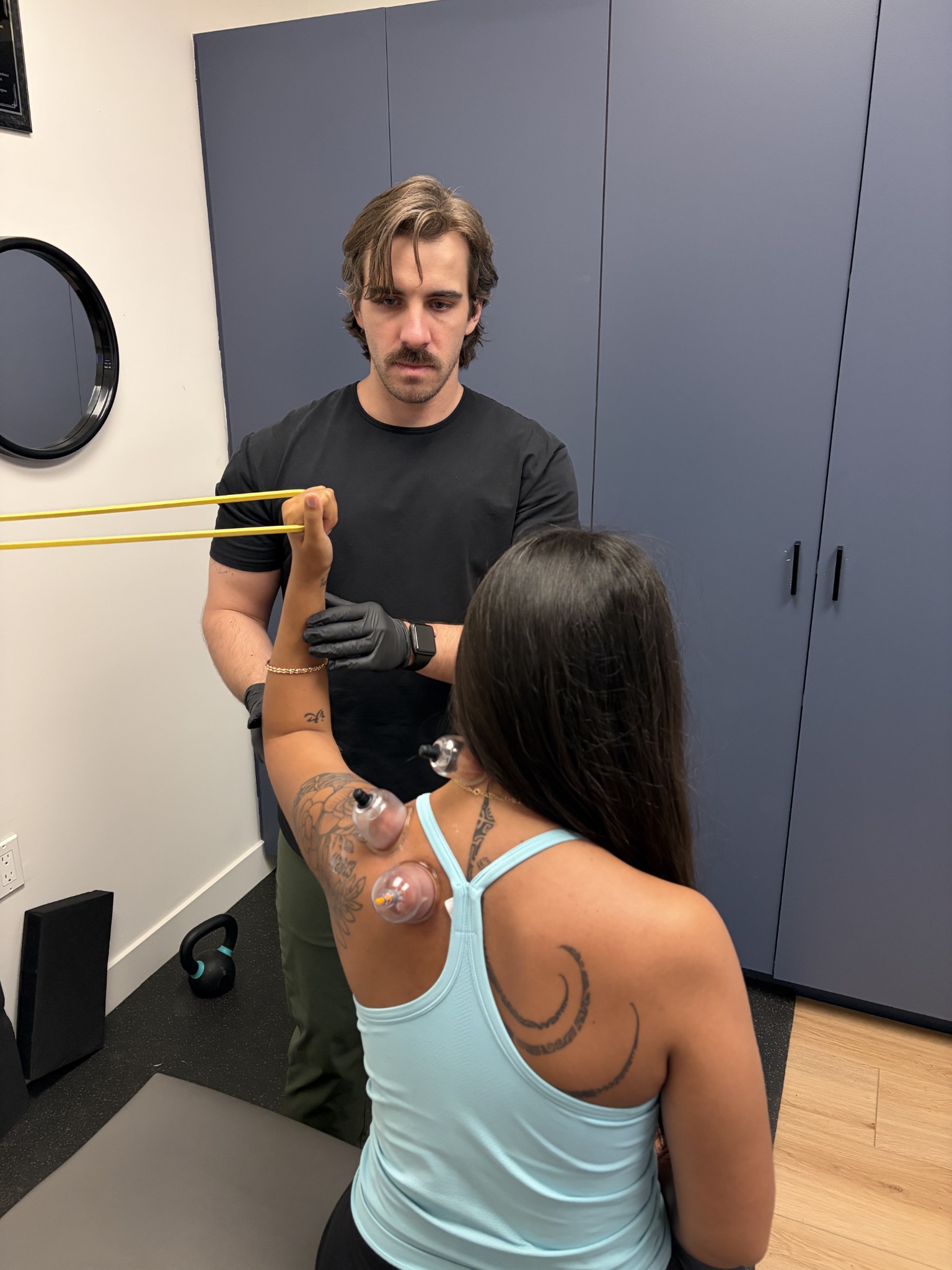
Rather than simply placing cups on the body and leaving them in one position, MFD incorporates targeted suction with active movement, mobility exercises, and soft tissue treatment to address movement restrictions and improve how your body functions.
Let’s break down why that matters.
What Is Myofascial Decompression?
Myofascial Decompression uses negative pressure to lift and decompress the underlying soft tissues.
Unlike traditional massage techniques that apply compressive force to the body, MFD creates a lifting force through suction.
The cups are strategically placed over areas of restricted soft tissue, and movement is incorporated while the cups are applied. This allows us to work with the tissues while they’re moving rather than simply treating them in a stationary position.
Think of it as combining soft tissue therapy with movement-based rehabilitation.
The goal isn’t just to make a muscle feel temporarily looser. It’s to help improve tissue mobility, address movement restrictions, and make it easier to move through the ranges of motion your body needs.
How Is This Different From Traditional Cupping?
Although both techniques use suction, their treatment philosophies are different.
Traditional Cupping:
- Often involves placing cups at specific locations and leaving them stationary for several minutes.
- Historically associated with traditional Chinese medicine and meridian-based treatment.
- Commonly used with the goal of promoting circulation, relaxation, and general symptom relief.
- Typically does not incorporate active movement while the cups are applied.
Myofascial Decompression:
- Uses targeted suction based on an individual’s movement assessment.
- Incorporates active and passive range-of-motion exercises while the cups are applied.
- Focuses on addressing specific soft tissue and movement restrictions.
- Combines manual therapy with neuromuscular re-education and functional movement.
Neither approach is inherently wrong. They simply have different applications and goals.
I utilize MFD because it fits the way I approach rehabilitation: identify the restriction, address the tissue, and then reinforce that change through movement.
We’re not just treating the area. We’re working on how that area moves.
What Are the Benefits?
MFD can be a useful addition to a comprehensive rehabilitation and performance program.
Some potential benefits include:
1. Improved Mobility and Range of Motion
By applying decompressive forces while incorporating movement, MFD provides a different mechanical stimulus to the soft tissues. It can be useful when working on areas that feel restricted or when certain movements are difficult to perform comfortably.
2. Pain and Muscle Tension Management
The sensory input created by suction may influence how the nervous system processes pain. Some research on dry cupping has demonstrated short-term improvements in musculoskeletal pain, making it a potential tool for managing symptoms.
3. Local Circulation and Tissue Response
The negative pressure created by the cups produces changes in the local skin and superficial tissue response. This may influence local blood flow and microcirculation, although the exact mechanisms and their clinical significance are still being studied.
4. An Addition to Active Rehabilitation
This is where I particularly like using MFD. Rather than relying exclusively on passive treatment, we can incorporate movement into the process.
Whether we’re working on shoulder mobility, hip movement, hamstring flexibility, or general soft tissue restrictions, the cups can be used alongside exercises that reinforce the movements we’re trying to improve.
5. Addressing Movement Restrictions
Sometimes the area that feels restricted isn’t necessarily the only area that needs attention. By assessing how someone moves, we can identify where MFD may be useful and pair it with other interventions to address the bigger picture.
Who Can Benefit From Myofascial Decompression?
You don’t have to be a competitive athlete to benefit from movement-based soft tissue treatment.
MFD can be incorporated into treatment plans for people dealing with:
- Stiffness and restricted mobility.
- Neck, shoulder, and back discomfort.
- Hip and lower-body mobility limitations.
- Muscle tightness associated with training.
- Reduced flexibility.
- Post-exercise soreness and recovery needs.
- Movement restrictions following injury, when clinically appropriate.
Whether you’re lifting weights, running, playing sports, working at a desk, or simply trying to move without feeling stiff all the time, improving how you move matters.
Why I Use Myofascial Decompression
My approach to treatment has always been centered around getting people moving better, not just chasing symptoms.
I believe soft tissue treatment has its place, but it should be part of a bigger picture.
That’s why I prefer incorporating MFD rather than relying solely on traditional stationary cupping. It allows me to combine targeted soft tissue work with active movement and rehabilitation.
The cups are a tool, not the entire treatment.
The goal is to use that tool to help you move better, build capacity, and get back to doing the things you enjoy.
Because feeling better is great. Being able to move better is even better.
Ready to give your soft tissues a little breathing room?
Let’s get you moving.